Fat-Tire vs. Standard-Tire E-Bikes for Commuting: Which Fits Your Ride?
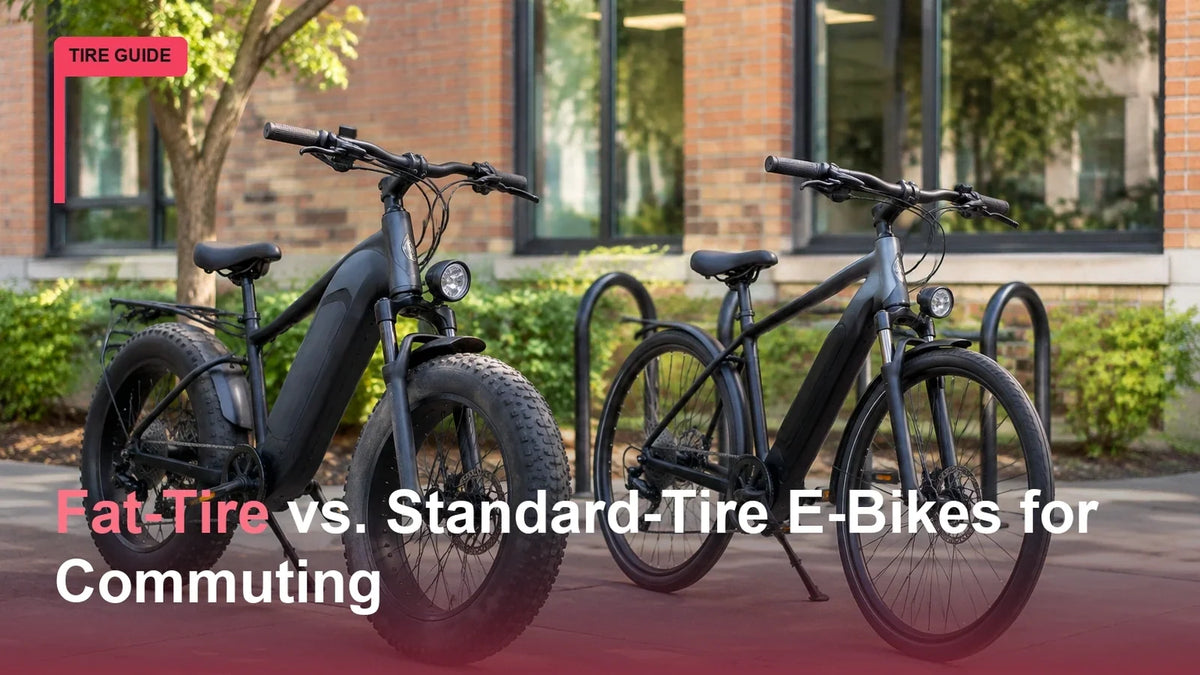
Park a fat-tire e-bike next to a traditional city commuter and the difference is impossible to miss. One looks like it was built to cross a beach; the other looks like the bicycles you have seen in bike lanes for decades.
Because four-inch tires look rugged, many first-time buyers assume fat tires are an all-around upgrade—more stability, more comfort, more bike for the money. On the other side, traditional cyclists often dismiss fat tires as pure off-road styling that has no business on pavement.
For a daily city commute, neither extreme holds up. Tire width is a straightforward mechanical trade-off between cushioning and surface grip on one side, and rolling efficiency, lighter handling, and rack compatibility on the other.
You also do not have to pick a frame style just to get the tire width you want. Both compact 16- or 20-inch frames and full-size 26-inch frames come in narrow-tire and wide-tire builds. If you are still sorting out your broader commuter requirements, start with our pillar guide, How to Choose an E-Bike for Your Daily Commute, and if apartment storage or train travel is part of your routine, pair this article with our frame comparison on folding vs. full-size e-bikes for city commuting.
Here is how fat tires and standard commuter tires actually behave on weekday streets—from potholes and wet manhole covers to the metal wheel slots in your office bike room.
Tire Width Basics: What Are We Comparing?
When bike spec sheets list tire dimensions—such as 26" × 1.95" or 20" × 4.0"—the first number is the outer diameter of the wheel in inches, and the second number is the width of the tire casing. Most commuter e-bikes fall into three width bands:
Standard commuter tires (roughly 1.5" to 2.1" wide)
These are the traditional widths found on city, hybrid, and trekking bikes. They use a narrower casing inflated to higher air pressure, which keeps the rubber firm against smooth asphalt. The priority here is low rolling drag, crisp steering response, and keeping the overall wheel weight down.
Mid-width urban and all-road tires (roughly 2.2" to 2.8" wide)
Sometimes called "plus" or balloon commuter tires, these split the difference. They add enough air volume to take the sting out of cracked pavement without jumping all the way to a heavy fat-bike rim.
Fat tires (3.0" to 4.0" or wider)
Originally developed for loose snow and sand, 3.0-inch and 4.0-inch tires have become a staple on compact and all-terrain commuter e-bikes. Because the tire casing holds a large volume of air, it can run at lower pressure than a narrow road tire, allowing the tire itself to deform over bumps and spread your weight across a wide contact patch.
Within UrlifeBike's commuter lineup (per the official store feed), you can see both approaches clearly: the compact URLIFE T16 uses 16" × 3.0" tires, the URLIFE E20 rolls on 20" × 3.0" tires, the URLIFE E20 Pro steps up to full 20" × 4.0" fat tires, and the full-size URLIFE E26 uses traditional 26-inch urban commuting wheels.
Rolling Resistance, Speed, and Battery Drain
What rolling resistance feels like on the road
Every time a tire rolls forward, the rubber flexes where it meets the pavement. A narrow, firmer tire flexes very little, so most of your pedaling effort and motor power goes straight into forward motion. A wide, softer tire puts more rubber on the ground and flexes more with every rotation, plus it often carries heavier tread blocks.
On an unassisted bicycle, that extra drag is exhausting. On an e-bike, the motor masks most of the effort at your legs—which is why fat-tire commuter bikes became viable in the first place—but the physics do not disappear. The energy simply comes out of your battery pack instead of your thighs.
You also hear and feel the difference. On smooth asphalt at 18 mph, a standard commuter tire makes a quiet hiss and coasts easily when you stop pedaling. A 4.0-inch knobby fat tire produces a noticeable hum and slows down sooner when you let off the pedals.
How tire width affects your real-world range
Because wider, softer tires require more energy per mile to push, they reduce how far a given battery can take you on a single charge.
In the open range-calculation model published by MathBikes (an independent e-bike comparison database), tire choice is scored with a direct energy-consumption multiplier:
-
Road tires:
× 1.00baseline energy use -
Hybrid / commuter tires:
× 1.10(about 10% more energy per mile than road tires) -
Knobby / fat tires:
× 1.25(about 25% more energy per mile than road tires)
As MathBikes explains in its methodology documentation, those multipliers are calibrated model constants rather than physical road tests of every tire tread, and they note that "knobby tyres cost around a quarter of the range" compared with smooth road rubber.
What this means for your commute:
- If your round trip is short (under 10 miles): That extra rolling drag barely matters. Almost any modern commuter battery will cover the trip with plenty of charge left over, and you will simply plug in overnight as usual.
- If your round trip is long (15 to 25+ miles) or steep: The tire penalty adds up. Manufacturers frequently pair fat-tire e-bikes with larger battery packs—such as 624 Wh (48V 13Ah) or ~749 Wh (48V 15.6Ah)—precisely to offset the extra drag. If you are comparing a standard-tire bike and a fat-tire bike with the exact same watt-hour battery, expect the standard-tire bike to go farther per charge.
Comfort and Cushioning: The Bumps You Feel
If standard tires win on efficiency, fat tires win the moment the pavement falls apart.
Potholes, utility trenches, and wrist fatigue
City streets are rarely smooth ribbons of fresh asphalt. They are a patchwork of sunken utility cuts, frost heaves, brick crosswalks, diagonal rail tracks, and crumbled curb edges.
On a standard commuter tire, you feel that texture through the handlebars and saddle. You quickly learn the habit every city cyclist knows: scanning the lane twenty feet ahead, unweighting your saddle over sharp seams, and steering around deep potholes so you don't pinch the inner tube against the metal rim.
On a 3.0-inch or 4.0-inch tire, the air volume acts as a built-in first layer of suspension before your fork even moves. Shallow potholes and rough chip-seal pavement flatten out into dull thuds rather than sharp jolts. Over a 45-minute ride, that extra cushioning noticeably reduces chatter in your wrists, shoulders, and lower back.
Pairing tires with mechanical suspension
Tire volume and mechanical suspension work together. A full-size 26-inch commuter bike with a front suspension fork—like the URLIFE E26—uses its large wheel diameter to roll smoothly over ridges while the fork absorbs bigger hits.
When you combine wide tires with suspension—such as the front suspension on the 20" × 4.0" URLIFE E20 Pro or the front-and-rear full suspension on the 16" × 3.0" URLIFE T16—you get a plush, forgiving ride even on smaller wheel diameters. For a closer look at how forks, frames, motors, and batteries work together, see Understanding the Core Components of an Electric Bike.
Parking, Storage, and Bike Rack Fit: The Hidden Catch
This is the section most buyer's guides leave out, and it is where many fat-tire buyers get caught off guard on day one.
Office bike rooms and public wheel-slot racks
Think about the bike racks at your workplace, grocery store, or transit station.
- Inverted-U racks (staple racks) and post-and-ring racks: Both tire types work fine here because you simply lean the frame against the bar and lock the triangle.
- Wheel-bender / slot racks, vertical wall hooks, and two-tier apartment racks: Many commercial bike rooms and municipal racks use metal channels or hanging hooks sized for standard bicycle tires (typically up to about 2.1 or 2.3 inches wide). A 3.0-inch or 4.0-inch tire physically will not slot into a narrow wheel tray or standard wall hook.
Nothing is more frustrating than rolling into your building's secure bike cage on Monday morning and realizing your front wheel won't fit into the assigned rack. Look at the actual rack hardware where you park before you buy.
Bus racks, car racks, and apartment hallways
The same check applies whenever the bike isn't on the ground:
- Municipal bus front racks: Transit bus racks have spring-loaded arms designed around standard wheel diameters and standard tire widths. Many transit agencies explicitly prohibit fat-tire bikes or wheels smaller than 16–20 inches on front bus racks. Always verify your local agency's rack rules.
- Car hitch racks: A standard car bike rack uses narrow wheel cradles and short straps. Carrying a fat-tire e-bike by car requires a hitch rack rated for heavy e-bikes and equipped with wide fat-tire wheel trays.
- Hallways and weight: Wider rims, wider casings, and wider forks add bulk and weight. If you carry your bike up apartment stairs or store it in a narrow entryway, a standard-tire build is trimmer to maneuver around doorframes.
Weather and Road Condition Performance
Wet pavement, painted lines, and autumn leaves
Wet city riding is less about deep mud and more about slick road paint, wet steel utility plates, oily intersections, and damp autumn leaves.
A wider tire running at moderate pressure puts a larger footprint of rubber on the street, giving you a comforting margin of grip when braking or cornering on imperfect wet pavement. Just remember that tread pattern and rubber compound still matter: a fat tire with tall, widely spaced off-road knobs can actually feel squirmy when leaned over on wet asphalt, whereas a street-oriented or all-terrain tread with Siping channels water away much more predictably.
Gravel shortcuts, canal paths, and winter slush
If your route includes an unpaved park connector, a crushed-limestone canal towpath, or poorly plowed winter side streets, wide tires shine. Where a narrow tire can dig into soft gravel or get deflected by frozen ruts, a 3.0-inch or 4.0-inch tire floats across loose surfaces and keeps tracking straight.
Regardless of tire width, winter commuting requires extra care for your battery, brakes, and visibility—read our seasonal guide, Winter Care & Riding Tips for Electric Bikes, before cold weather sets in.
Cost, Upfront Pricing, and Maintenance Reality
Upfront bike price
Across the broader e-bike market, fat-tire models and standard-tire commuters overlap heavily in price; battery capacity, motor power, and drivetrain components drive the sticker price far more than rubber width.
In UrlifeBike's current collection feed, for instance, the standard-wheel 26-inch URLIFE E26 (48V 10.4Ah battery, 750W peak motor) and the compact 16" × 3.0" URLIFE T16 (48V 13Ah battery, full suspension) are both listed at $479, while the 20" × 3.0" URLIFE E20 (48V 13Ah battery, 1000W peak motor) and the 20" × 4.0" URLIFE E20 Pro (48V 15.6Ah battery, 1500W peak motor) are both listed at $499. (Always check live product pages for current pricing and stock.)
Day-to-day maintenance and flat repairs
Both tire types need routine pressure checks and occasional flat fixes, but they have different quirks:
- Tire pressure habits: Narrow tires hold less air volume at higher pressure, so a small air loss over two weeks is easy to feel. Fat tires hold a large volume of air, but pressure is critical on a fat tire—let a 4.0-inch tire get too soft on pavement and steering turns heavy and sluggish (a feeling riders call "self-steering"), while rolling drag spikes. Check the PSI range stamped on your tire's sidewall and use a gauge rather than squeezing the tire by hand.
-
Tubes and shop stock: Every local bike shop stocks standard 26-inch inner tubes and tires. While
20" × 4.0"and20" × 3.0"sizes are now common, not every neighborhood shop keeps fat-bike tubes in every valve length on the shelf. Whichever wide-tire bike you buy, order one spare inner tube in your exact wheel size (16" × 3.0",20" × 3.0", or20" × 4.0") to keep at home so a Tuesday evening flat never costs you Wednesday's commute.
When to Choose Fat or Wide Tires (3.0"–4.0") for Commuting
Choose a fat-tire or wide-tire commuter e-bike if your daily ride matches this profile:
- Your streets are rough: Cracked asphalt, potholes, brick sections, or poorly maintained shoulders where maximum cushioning saves your wrists and back.
- Your route mixes surfaces: Paved bike lanes combined with gravel park paths, dirt shortcuts, sandy coastal streets, or winter slush.
- You value planted confidence over nimble road-bike steering: You want a wide footprint that shrugs off pavement seams and longitudinal cracks.
- Your parking is open: You lock to U-racks, posts, or park in a garage or patio rather than slotting your front wheel into a narrow metal tray or vertical wall hook.
Where UrlifeBike models fit (specifications from UrlifeBike's official collection feed; verify current details on the product page before purchase):
-
URLIFE E20 Pro (20" × 4.0" Fat-Tire Electric Bike): Built for commuters who want full 4.0-inch fat-tire cushioning and strong hill power. It pairs
20" × 4.0"all-terrain fat tires and front suspension with a 750W rated (1500W peak) rear hub motor, Shimano 7-speed gearing, fenders, lights, and a removable 48V 15.6Ah (about 749 Wh) battery rated in the listing for up to 85 miles in PAS mode. -
URLIFE E20 (20" × 3.0" Fat-Tire Commuting Electric Bike): A slightly trimmer 3.0-inch width that balances fat-tire stability with everyday commuting utility. It includes
20" × 3.0"tires, a 1000W peak motor, front suspension, a sturdy rear rack, full fenders, LED lighting, Shimano 7-speed gearing, and a removable 48V 13Ah (624 Wh) battery rated in the listing for up to 80 miles. -
URLIFE T16 (16" × 3.0" Compact Electric Bike): Combines a smaller 16-inch wheel footprint with
16" × 3.0"wide tires, front and rear full suspension, disc brakes, and a removable 48V 13Ah (624 Wh) battery.
When to Choose Standard Tires (1.5"–2.1") for Commuting
Choose a standard-tire commuter e-bike if your daily ride matches this profile:
- Your route is mostly paved: City streets, protected bike lanes, and paved greenways where smooth rolling and quieter tires make the ride feel effortless.
- You want maximum miles per watt-hour: You want your battery capacity going into distance rather than overcoming wide-tire drag, and you want the bike to pedal more naturally if the battery ever runs low.
- You use standard bike racks or transit racks: Your office bike cage uses narrow wheel slots, vertical hanging hooks, or you rely on municipal bus front racks.
- You prefer lighter, bicycle-like handling: Quicker turn-in, narrower hallway storage, and easier lifting over curbs.
Where UrlifeBike models fit (specifications from UrlifeBike's official collection feed; verify current details on the product page before purchase):
- URLIFE E26 (26" Urban Commuting Electric Bike): Designed around traditional 26-inch urban wheels for efficient street riding. It pairs its 26-inch wheelset with a 750W peak motor, front suspension fork, Shimano 7-speed shifting, mechanical brakes, full fenders, a rear rack, LED lighting, and a removable 48V 10.4Ah (about 499 Wh) battery rated in the listing for up to 100 miles.
Fat-Tire vs. Standard-Tire Decision Matrix
Use this side-by-side table to match the tire to your actual commute constraints:
| Commute factor | Fat / Wide Tire (3.0"–4.0") | Standard Commuter Tire (1.5"–2.1") | Winner for City Commuting |
|---|---|---|---|
| Rolling efficiency & range per Wh | Higher rolling drag (MathBikes models knobby/fat tires at × 1.25 energy use vs. road) |
Lower rolling drag (× 1.00 to × 1.10 in the same model) |
Standard tire wins |
| Potholes & broken asphalt | Large air volume absorbs sharp hits and reduces wrist/back chatter | Firmer ride; relies on larger wheel diameter or suspension fork | Fat tire wins |
| Gravel paths, sand & winter slush | Wide contact patch floats over loose or slushy surfaces | Best on firm pavement and hard-packed paths | Fat tire wins |
| Smooth bike-lane speed & quietness | Audible tire hum; heavier steering feel | Quiet roll; crisp, responsive handling | Standard tire wins |
| Pedaling with assist turned off | Heavy and tiring to pedal unassisted | Feels much closer to a traditional bicycle | Standard tire wins |
| Office wheel-slot racks & wall hooks | Often too wide for narrow metal trays or standard wall hooks | Fits virtually all commercial bike racks | Standard tire wins |
| Municipal bus front racks | Frequently restricted by width/wheel rules (check agency policy) | Fits standard transit bus racks | Standard tire wins |
| Hallway & apartment footprint | Wider bars/forks and bulkier visual profile | Trimmer profile against a hallway wall | Standard tire wins |
On smooth city pavement, standard tires win more rows here, and that is the honest result for most downtown commutes. The count is not the decision, though: if two or three of the rough-surface rows describe your actual route, the comfort and grip advantage dominates your ride, and the efficiency difference is the smaller number in the trade.
Practical Checklist Before You Choose Tire Width
Run through these four quick checks before you order:
1. Audit your road surface
- I have ridden or driven my exact commute route and noted whether it is mostly smooth asphalt, deeply potholed pavement, or mixed gravel.
- I know whether I plan to ride through wet winters, snow, or unpaved park connectors.
2. Check your racks at both ends
- I have looked at the bike rack at work (and at home) to see if it uses U-bars (fits anything) or narrow wheel slots / vertical hooks (often standard-tire only).
- If I use a bus rack or a car hitch rack, I have checked its maximum tire-width rating in inches.
3. Balance battery size against tire drag
-
I have compared candidate bikes by battery watt-hours (
V × Ah), not just "up to" mileage claims. - If I am choosing 3.0" or 4.0" fat tires for a medium or long commute, I have accounted for their higher rolling consumption (or picked a larger 624–749 Wh pack).
4. Plan for simple upkeep
- I have a floor pump with a pressure gauge so I can keep wide or narrow tires at their proper sidewall PSI.
- I will keep one spare inner tube in my bike's exact wheel and width size at home.
Final Recommendation: Let Your Streets and Your Racks Decide
Ignore the debate over which tire looks cooler and answer two practical questions: How beat-up is your pavement, and where do you lock the bike?
- Pick standard commuter tires (like the 26-inch URLIFE E26) if your route stays on paved city streets, you park in standard office racks or tight apartment spaces, and you want the quietest, most battery-efficient roll.
- Pick 3.0-inch or 4.0-inch fat tires (like the URLIFE E20, URLIFE E20 Pro, or compact URLIFE T16) if your city streets are scarred with potholes, your commute cuts across gravel or winter slush, and you have open U-rack or garage parking where extra tire width causes zero storage headaches.
Ready to match tire width with motor type, frame style, and budget? Visit our complete How to Choose an E-Bike for Your Daily Commute guide, or compare full specifications across the UrlifeBike electric bike collection.
The right tire is the one you stop thinking about after the first week, because it just works for where you ride.
Sources and Further Reading
- MathBikes, E-Bike Range Calculator (published tire consumption multipliers: road
× 1.00, hybrid× 1.10, knobby/fat× 1.25): https://mathbikes.com/calculators/range - MathBikes, Methodology (explanation of tyre consumption modelling and catalogue constants): https://mathbikes.com/methodology