Folding vs. Full-Size E-Bike for City Commuting: Which Fits Your Lifestyle?
When you live in a walk-up apartment or split your commute between a bike lane and a commuter train, a folding e-bike looks like the obvious answer. When you picture yourself riding 12 miles over cracked city asphalt at 20 mph, a full-size e-bike looks like the only sensible choice.
Most buyers get stuck right between those two images.
The mistake is treating folding and full-size e-bikes as if one is a "real" bike and the other is a compromise. A folding frame solves the problem of what to do with the bike when you aren't riding it. A full-size frame solves the problem of how the bike feels when you are.
What surprises many first-time buyers is where the two categories overlap. Folding an e-bike does not automatically make it light, and buying a full-size frame does not automatically give you more battery range. The right choice comes down to your storage reality, whether you carry the bike up stairs or onto transit, and how rough your roads are.
This guide walks through those trade-offs in the order they matter on a weekday morning. If you are still working out your broader setup—motors, classes, brakes, and test-ride checks—start with our pillar guide: How to Choose an E-Bike for Your Daily Commute.
Your Storage and Transport Reality
Before comparing wheel sizes or motor watts, look at the two ends of your commute. Where the bike sleeps at night and where it waits while you work will eliminate half your options in five minutes.
Do you need portable or stationary storage?
At home, a full-size e-bike needs a dedicated, ground-level footprint: a garage, a backyard shed, a secure building bike room, or a heavy-duty outdoor rack where you are genuinely comfortable leaving a thousand-dollar machine overnight. If you bring a full-size bike into a studio or one-bedroom apartment, it dominates the hallway.
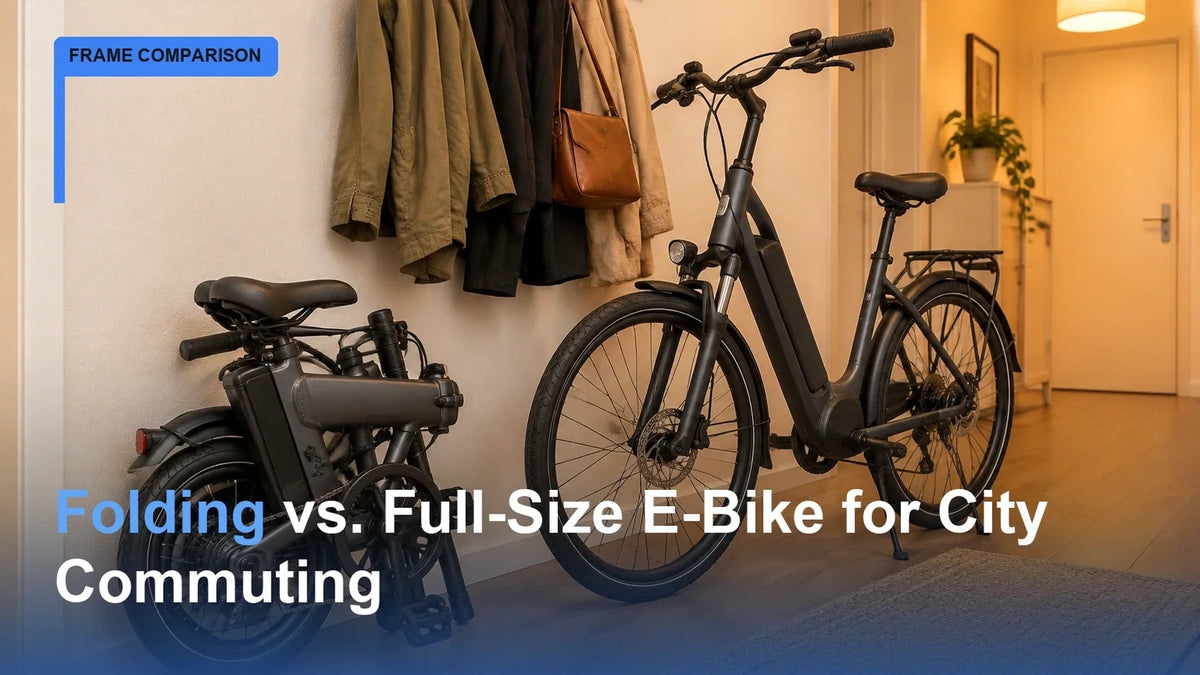
A folding e-bike trades wheel diameter and frame length for a footprint that can tuck into a front hall closet, slide beside a sofa, or sit in a stairwell nook. Even folded, it still takes up floor space—it is a folded machine, not a backpack—but it turns an impossible apartment layout into a workable one.
At work and on transit, the gap widens. If your office has no bike cage and street theft in your neighborhood is high, a folding model that fits under your desk or in a coat room solves security completely.
If your commute includes a train or bus, check your transit operator's rules before you shop. Many rail agencies forbid full-size bikes during peak commuter hours while allowing folded e-bikes on board, sometimes requiring a carry bag or specific maximum dimensions. Because MathBikes' comparison of folding and full-size e-bikes notes that "not every folding bike folds small enough to be truly convenient," never rely on the word "foldable" alone. Measure your closet opening or check your rail agency's size limit, then compare it against the bike's published folded dimensions.
Weight matters if you carry it—and folding doesn't mean light
Here is the trap that catches apartment commuters: assuming a smaller frame weighs less.
Hinges, reinforcement plates, latches, and thick tubing add mass. According to MathBikes' e-bike catalogue analysis, the lightest e-bike in their database is actually a full-size city bike (the Fiido Air Carbon at 13.6 kg, or about 30 lb), while the heaviest model in their entire catalogue is a folding bike (the Hiboy C1 at 56.7 kg, or about 125 lb). Across all 275 bikes in their database, the median weight is 28.1 kg (about 62 lb).
As MathBikes notes in that same guide, if you must carry your bike regularly, you should look for a model under 20 kg (about 44 lb)—and expect to pay more for that lightness.
You learn why that threshold exists the first time you haul a heavy frame up a narrow third-floor walk-up after work, trying not to bang a pedal into the drywall while your keys are still in your pocket. A hinge helps you pivot around a tight landing, and removing the battery first trims a few pounds, but your arms still lift the total weight. Before you buy either style for a walk-up, load a suitcase or duffle bag to match the bike's listed weight and carry it up your stairs once. Your staircase will give you a clearer answer than any review site.
Ride Quality and Comfort: The Wheel Size Impact
Once you are out on the street, the physics shift in favor of the full-size frame.
Wheel size and stability at speed
Most full-size commuter e-bikes roll on 26-inch to 29-inch wheels, while folding and compact e-bikes typically use 14-inch to 20-inch wheels.
A larger wheel has a shallower angle of attack when it hits a pothole, expansion joint, or tree root. Instead of dropping into the gap, it bridges across it. Larger wheels also carry more gyroscopic stability once you are moving. As MathBikes explains in its folding vs. full-size guide: "Full-size bikes with larger wheels are more stable at speed and in corners. Folding bikes with smaller wheels accelerate quickly but can feel less stable on descents."
In stop-and-go downtown traffic, small wheels are genuinely fun. They spin up briskly from a red light and let you thread around a double-parked delivery van with very little steering input. Above 18 or 20 mph, or on a fast downhill with crosswinds, that same quick steering feels twitchier and demands more attention at the handlebars.
Wheelbase, suspension, and rough pavement
Wheel size works alongside wheelbase—the distance between the front and rear axles. Full-size frames have a longer wheelbase, which keeps your weight centered between the wheels and calms the chassis over uneven pavement.
Because compact frames have a shorter wheelbase and smaller wheels, suspension and tire volume do more of the heavy lifting for comfort. As MathBikes points out, many full-size e-bikes include front suspension forks and some offer full suspension, whereas folding bikes less commonly include full suspension setups. However, exceptions exist in compact commuter lineups—for example, UrlifeBike's 14-inch URLIFE F1L pairs a folding frame with front fork and mid-frame suspension, and the 16-inch URLIFE T16 uses front and rear suspension with 3.0-inch wide tires to cushion city bumps.
For a deeper look at how frames, forks, motors, and batteries interact as a system, read our component walkthrough: Understanding the Core Components of an Electric Bike.
Frame size and rider fit
Full-size e-bikes often come in multiple frame sizes or distinct step-through and high-step geometries, making it easier for very tall or very short riders to dial in proper leg extension and handlebar reach.
Folding e-bikes almost always use a one-size-fits-all frame with a long telescoping seatpost and an adjustable handlebar stem. For average-height riders on a 20- or 30-minute commute, that adjustment range works fine. If you are at either end of the height spectrum—or if your commute keeps you in the saddle for an hour each way—check the reach, stack, and minimum/maximum saddle height carefully. Small fit compromises that feel minor in a parking lot start talking to your knees and lower back by mile ten.
Range: Battery Capacity, Not Frame Style
One of the most persistent myths in commuter cycling is that folding e-bikes can only handle three-mile errands while full-size bikes go three times as far.
Why the hinge doesn't determine how far you go
Range is governed by battery capacity in watt-hours (Wh), assist level, rider weight, tire rolling resistance, wind, and terrain—not by whether the frame has a latch in the middle.
Data from MathBikes' catalogue illustrates how closely the two categories track when battery size is similar:
- VTUVIA SF20 (folding): 720 Wh battery → about 52 km (32 mi) estimated range
- Lectric XPress (full-size): 672 Wh battery → about 48 km (30 mi) estimated range
- Fiido D3 Pro (folding): 374 Wh battery → about 28 km (17 mi) estimated range
- Troxus Trax Plus (full-size): 1,440 Wh battery → about 95 km (59 mi) estimated range
Across their range model for ordinary commuting (moderate Tour assist on rolling terrain), MathBikes maps battery capacity to realistic distance like this:
| Battery capacity | Estimated ordinary range (MathBikes model) |
|---|---|
| 346–374 Wh | 23 km (about 14 mi) |
| 720 Wh | 48 km (about 30 mi) |
| 1,056 Wh | 70 km (about 44 mi) |
(Source: MathBikes folding vs. full-size guide; calculated estimates for moderate assist on rolling terrain, not road-test guarantees.)
Ultra-compact folding frames have less physical room for huge packs, so you will see more 350–500 Wh batteries on 14-inch folders and more 700+ Wh packs on larger frames. Still, compare watt-hours rather than frame style.
Advertised range vs. your morning commute
Whether a bike folds or not, treat the "up to X miles" figure on the box as a ceiling. In MathBikes' analysis of 275 e-bikes, 271 models claimed more than their standardized estimate, with a median overclaim of 50 percent (a formula-based comparison between best-case flat riding and a rolling commute, not a physical road test). Plan on roughly half to two-thirds of the advertised maximum, and pick a battery that covers your round trip plus a 20–30% buffer.
Weight and Portability in Daily Use
Portability is more than a spec-sheet number; it is how the bike behaves when you aren't pedaling.
Living with a folding bike
A good folding routine takes practice. As MathBikes points out, a bike that takes five minutes of wrestling to fold will rarely get folded. When shopping, look at where the weight sits when the frame is doubled over, whether a magnet or strap holds the wheels together, and whether you can roll it on one wheel through a station concourse instead of dead-lifting it.
Also remember that hinges, latches, and folding stems are moving structural joints. They keep the bike compact, but they are extra hardware to keep clean, properly tensioned, and inspected according to your owner's manual.
Living with a full-size bike
A fixed diamond or step-through frame has no central hinge to adjust or inspect. You unlock it, turn it on, and ride. If you ever need to take it out of town by car, however, you will need a hitch-mounted rack rated for e-bike weights rather than an empty trunk.
Cost Comparison: Purchase Price and Five-Year Ownership
Upfront price: no frame-style tax
You do not pay a built-in premium—or get an automatic discount—just by choosing a folding or full-size frame.
In MathBikes' catalogue, prices run from $399 USD (the Fiido D3 Pro, a folding model) to $4,499 USD (the Cyrusher Trident, a full-size mountain bike), with a catalogue-wide median price of $1,399 USD. Full-size city bikes in their database start around $500 USD (such as the VIVI C26UL). As their guide concludes, price "depends more on brand, components, and battery size than on frame style."
Within UrlifeBike's own commuter lineup (per the official store feed), entry and mid-tier pricing follows a similar pattern driven by battery and hardware: the 14-inch folding URLIFE F1L is listed at $299, while the 16-inch compact URLIFE T16 and the 26-inch full-size URLIFE E26 are both listed at $479, and the 20-inch fat-tire URLIFE E20 is listed at $499. (Check live product pages before ordering, as store pricing and promotions change.)
Five-year ownership costs
To see how running expenses compare over time, MathBikes' five-year cost of ownership model treats battery replacement and servicing as the two largest ongoing costs, and models resale at about 24% of the original purchase price after five years.
Crucially, their servicing estimate is driven by motor layout: over the same period, mid-drive servicing runs about 50% higher than hub-motor servicing. Battery replacement scales with capacity rather than with frame design. Those are one European model's assumptions, not UrlifeBike shop rates, so they are given here as proportions and relationships rather than amounts. That is also how they transfer: multiply the shares by your own purchase price. The principle holds everywhere, because long-term cost follows battery size and drivetrain type, not the hinge.
When to Choose a Folding or Compact E-Bike
A folding or compact model is the rational choice if your daily routine looks like this:
- You live in a small apartment (studio or one-bedroom) with no garage or secure bike room, and the bike must live indoors.
- You combine cycling with public transit—riding a few miles to a commuter rail or bus line and bringing the bike with you (once you have confirmed your operator's rules).
- Office security is DIY—you want to bring the bike inside and tuck it near your workspace rather than locking it to a street sign for eight hours.
- You want car-trunk flexibility—throwing the bike in the back of a hatchback for weekend trips or rainy-day bailouts without buying a hitch rack.
- Your round trip is short to medium (under 15–20 miles total) at moderate city speeds.
Where UrlifeBike models fit (specifications from UrlifeBike's official collection feed; verify current details and folded measurements on the product page before purchase):
- URLIFE F1L (14" Folding Electric Bike): Built specifically for tight spaces and short urban hops. It uses 14-inch wheels, a foldable carbon-steel frame, dual suspension (front fork plus mid-frame shock), mechanical brakes, a rear rack, LED lights, and a keyed 48V 7.5Ah (360 Wh) battery rated in the listing for up to 40 miles. The feed lists its variant weight at 24,500 g (about 24.5 kg / 54 lb).
- URLIFE T16 (16" × 3.0" Compact Electric Bike): A compact non-folding alternative if you want a smaller footprint than a 26-inch bike alongside a larger battery and wider tires. It pairs 16" × 3.0" fat tires and front-and-rear suspension with a removable 48V 13Ah (624 Wh) battery rated in the listing for 60–80 miles, plus front and rear disc brakes.
- URLIFE E20 (20" × 3.0" Fat-Tire Commuter): Steps up to 20" × 3.0" tires, a 1000W peak motor, Shimano 7-speed gearing, front suspension, fenders, a rear rack, and a removable 48V 13Ah (624 Wh) battery.
Trade-offs you accept: quicker, more sensitive steering at higher speeds; one-size-fits-all frame geometry; and, on folding models, hinge latches to keep clean and checked.
When to Choose a Full-Size E-Bike
A full-size commuter e-bike is the better tool if your routine looks like this:
- You have ground-level, secure parking at home (garage, shed, or dedicated bike room) and a safe lock-up spot at work.
- Your commute is longer or faster—10 to 20+ miles round trip where planted handling at 20 mph+ and efficient rolling save energy and mental fatigue.
- Your city streets are beat up—potholes, trolley tracks, and patched utility trenches where 26-inch or larger wheels smooth out the chatter.
- You ride for recreation on weekends and want a traditional bicycle stance and pedaling feel.
- You don't need to take the bike onto trains, buses, or up narrow apartment stairs.
Where UrlifeBike models fit (specifications from UrlifeBike's official collection feed; verify on the product page before purchase):
- URLIFE E26 (26" Urban Commuting Electric Bike): A classic 26-inch wheel urban commuter with a 750W peak motor, Shimano 7-speed shifting, front suspension, mechanical brakes, full fenders, a rear rack, LED lighting, and a removable 48V 10.4Ah (about 499 Wh) battery rated in the listing for up to 100 miles. The feed lists its variant weight at 27,000 g (about 27 kg / 59.5 lb). Because the battery removes with a key, you can park the full-size frame in a garage or bike room and carry just the battery pack upstairs to charge.
Trade-offs you accept: a full-length hallway or garage footprint, no option to fold for a car trunk or peak-hour train, and needing a heavy-duty rack if you drive with it.
Hybrid Scenarios: Multi-Modal, Mixed Use, and Shared Bikes
Real life rarely fits a neat box. Here is how the two styles handle mixed routines:
- The "ride when it's nice, train when it pours" week: If your schedule or weather forces you to mix cycling, rail, and occasional rides home in a colleague's car, a folding bike removes the friction. You don't leave a bike stranded at the office overnight when an evening thunderstorm rolls in.
- Weekday commute plus weekend path riding: If your bike is both your Monday-through-Friday commuter and your Saturday two-hour greenway cruiser, a full-size 26-inch bike (or a 20-inch fat-tire model with a larger battery) is much more relaxing over long stretches.
- One bike shared between two apartment mates or partners: A folding or compact frame with a quick-release telescoping seatpost and adjustable stem adapts between two riders of moderate height in seconds, and tucks out of the way when neither person is riding. If one rider is 5'2" and the other is 6'3", however, test the adjustment limits carefully before assuming one frame fits both.
Folding vs. Full-Size Decision Matrix
Use this table to score which columns match your non-negotiables:

| Commute factor | Folding / Compact advantage | Full-Size advantage | Verdict |
|---|---|---|---|
| Small apartment / closet storage | Fits closets, corners, and under desks | Needs hallway, balcony, or bike room | Folding wins |
| Public transit (train / bus) | Often allowed when folded (verify agency rules) | Frequently restricted at peak hours | Folding wins |
| Car transport | Fits in most car trunks or back seats | Requires a heavy-duty hitch rack | Folding wins |
| Stability above 18–20 mph | Smaller wheels feel quicker and more sensitive | 26"+ wheels and longer wheelbase track calmly | Full-size wins |
| Rough pavement & potholes | Relies heavily on tire width and suspension | Larger wheels bridge bumps naturally | Full-size wins |
| Rider height extremes | One-size frame with adjustable post/stem | Traditional geometry and longer cockpit | Full-size wins |
| Carrying up stairs | Compact shape clears tight stair turns | Easier to shoulder only if ultralight | Tie — total weight (<20 kg per MathBikes) decides |
| Single-charge range | Tied to battery Wh (typically 360–720 Wh) | Tied to battery Wh (typically 500–1,000+ Wh) | Tie — compare watt-hours, not hinges |
| Upfront purchase price | Spans budget to premium | Spans budget to premium | Tie — components and battery drive price |
| Mechanical simplicity | Hinges and latches need periodic checks | Fixed frame has no folding joints | Full-size wins |
Your Pre-Decision Checklist
Run through these four blocks before you put a bike in your cart:
Storage & transport
- I have measured the exact spot where the bike will live at home and at work.
- If I use a train or bus, I have read my transit agency's written policy on e-bikes and folded dimensions.
- I have checked the bike's listed weight in pounds or kilograms—not assumed that "folding" means light.
- If I carry the bike up stairs daily, I have considered MathBikes' under-20 kg (44 lb) guideline or confirmed I can remove the battery to trim weight.
Ride quality & fit
- I have looked at the road surface on my actual route (smooth bike lanes vs. broken asphalt).
- I have checked the wheel diameter (14"–20" vs. 26"+) and suspension setup against those roads.
- I have checked the recommended rider height range and saddle adjustment limits.
Range & charging
- I have multiplied battery volts × amp-hours to compare true capacity in watt-hours (Wh).
- My target battery covers my round-trip distance plus a 20–30% buffer without relying on "up to" brochure claims.
- If I cannot park near an outlet, I have chosen a model with a removable battery.
Cost & upkeep
- I am comparing bikes by battery size, motor type, and brakes rather than paying extra just for a frame style.
- If buying a folder, I am ready to inspect the frame latch and stem joint as part of routine care.
Final Recommendation: Start With Constraints, Not Preferences
If you are still torn, decide in this strict order:
- Solve storage and transit first. If you have nowhere safe to lock a full-size frame, or you must bring the bike onto a peak-hour train or into a cramped elevator, buy a folding or compact bike. A smooth-riding 26-inch bike that gets stolen from the sidewalk or blocks your kitchen door is the wrong bike.
- Solve road feel and distance second. If you have a garage, a ground-floor bike room, or a secure cage at work, let your roads decide. For longer distances and rougher streets, the calmer steering and bump-smoothing roll of a full-size wheel will make every ride noticeably more pleasant.
- Treat range and price as battery questions. Once you pick your frame style, choose the watt-hour capacity that covers your route with room to spare.
Ready to put the rest of your commuter checklist together? Read our complete step-by-step buying guide, How to Choose an E-Bike for Your Daily Commute, or browse the UrlifeBike electric bike collection to compare the F1L, T16, E20, and E26 side by side.
Sources and Further Reading
- MathBikes, "Folding vs Full-Size E-Bikes: Which Should You Buy?" (updated September 5, 2026): https://mathbikes.com/guides/folding-vs-full-size-e-bikes-which-should-you-buy
- MathBikes, Methodology (how catalogue range and ownership estimates are calculated): https://mathbikes.com/methodology